
Your first study
Start with a modest literature question, for example: How does sleep affect memory consolidation? You need a Lykeion account and a computer with an authenticated supported agent CLI.
1. Open a workspace
Sign in and follow Laboratory onboarding. Choose an existing workspace or create one with a name, URL and card prefix. Continue through Skills and Connectors. Keep the default laboratory for your first attempt unless your lab has instructed otherwise.
2. Connect a machine
Use the download page to install the desktop app, which includes the daemon. Sign in to your lab account and install and authenticate Claude Code or Codex on that computer. For a remote computer, use the prebuilt CLI instructions on the same page, choose your workspace and start the daemon. Linux also needs bubblewrap. Open Settings → Machines to confirm the computer and intended runtime are online. See connect a machine for the complete setup.
3. Create the study
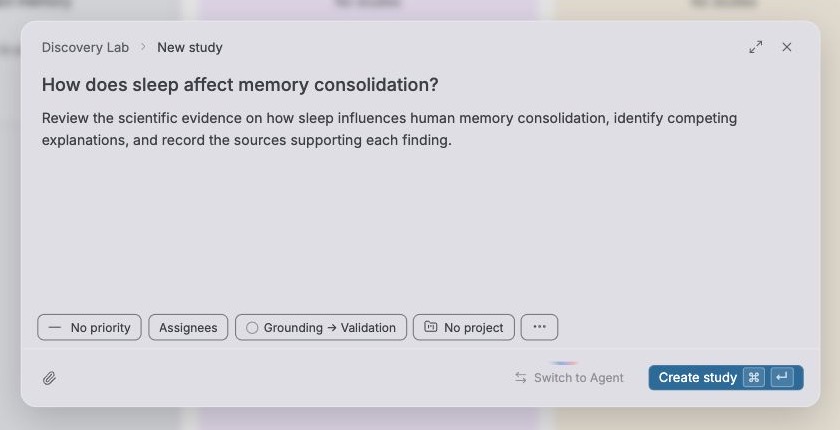
Open Studies and create a new study. Enter a short title and a description with your question, boundaries and requested output. Choose an available Grounding agent or a suitable Team and check the stage scope. For a small literature exercise, request a cited evidence summary and explicitly ask the agent to report inaccessible sources. Submit with Create study.
4. Follow progress
Open the new study. Read Activity and expand agent cards to follow execution. If it waits, inspect the selected machine, runtime health and reported error before submitting another study. Stage progress and review status are separate from a single agent's completion.
5. Inspect results
Read the hand-in and check its cited sources. Open Files for generated artifacts, Notebook for recorded computation and Review for available checks. An empty surface can mean that this work has not produced that kind of output yet.
You have completed this quickstart when you can identify the study, its assigned runtime and its first inspectable hand-in or a concrete blocker. A study reaches Done only after its configured stages and required review finish. Continue with the complete tutorial and evidence and results.